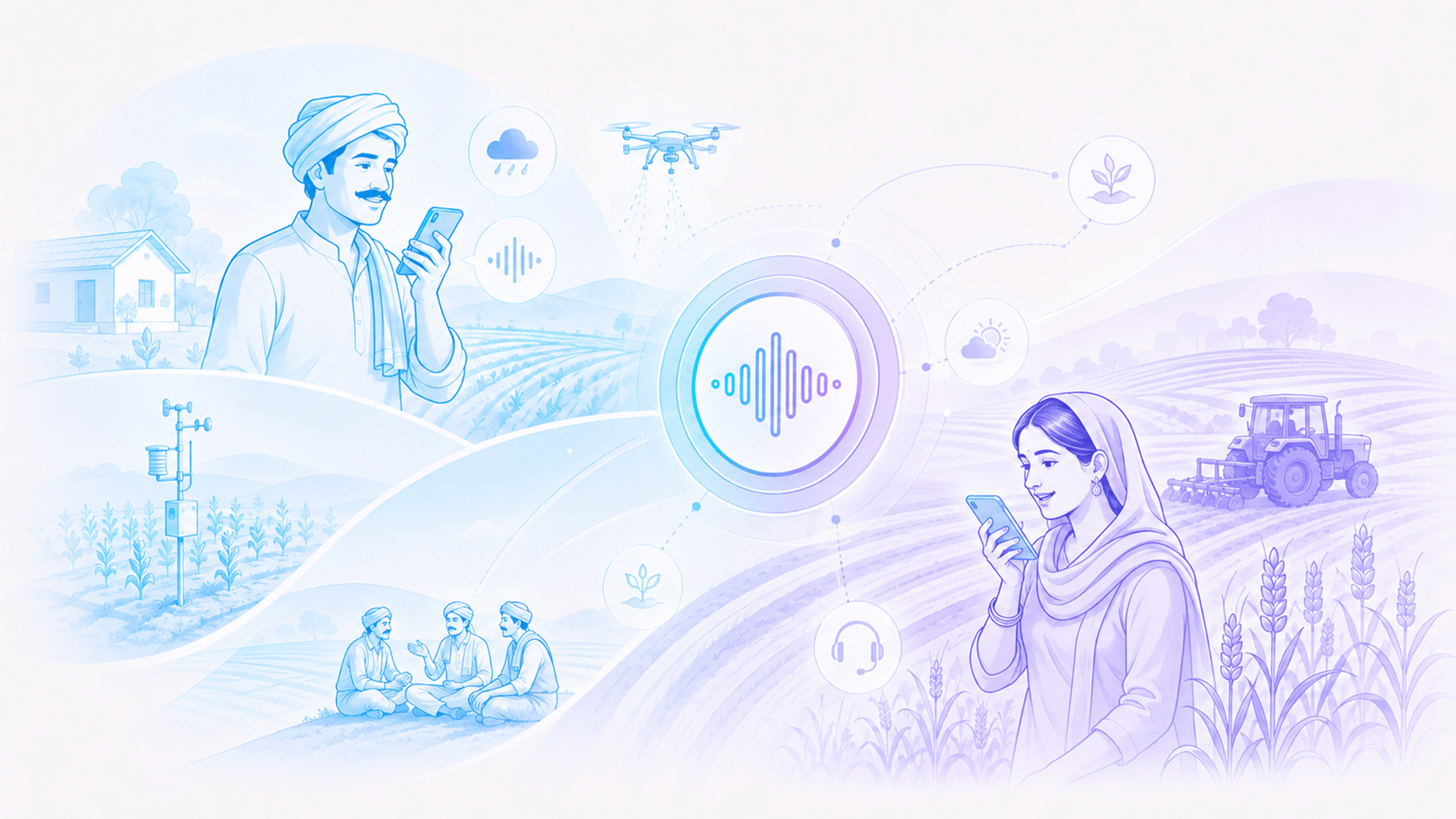


A farmer notices unusual spots on a crop after several days of rain. He wants to know whether it is a disease, whether he should wait, or whether he needs expert help.
The information may already exist somewhere: inside an agriculture app, a PDF, a product guide, a government portal, or with a field officer. The real problem is accessing that information quickly, in a language the farmer naturally speaks.
This is where Voice AI in Agriculture becomes valuable.
Instead of typing a question into an app, a farmer can simply ask it in Marathi, Hindi, Telugu, Gujarati, Tamil, Kannada, or another regional dialect and receive a spoken response based on trusted agricultural information.
For agriculture businesses, cooperatives, government departments, and agritech platforms, Voice AI can turn complex digital systems into something much simpler: a conversation.
Agriculture organizations have invested heavily in digital platforms, crop databases, mobile apps, weather services, dealer networks, and farmer-support programs.
But information only creates value when farmers can access it at the right moment.
Consider a farmer standing in a field preparing for irrigation. He may not want to:
He may simply want to ask:
“Should I irrigate my soybean field today if rain is expected tomorrow?”
A voice-based system can make that interaction far more natural.
The main accessibility challenges include:
Supporting Hindi or Marathi alone may not solve the problem. Farmers often use local vocabulary, regional pronunciation, mixed-language sentences, and crop-specific terms.
For example:
“Cotton la spray kadhi karaycha?”
is not a formal English or Marathi query. It is how many users naturally mix languages in daily conversation.
A useful Voice AI system has to understand the farmer, not force the farmer to change how they speak.
A mobile app may contain excellent information but still create friction if a farmer has to navigate five screens to find one answer.
Voice changes the experience from:
Search → Read → Interpret
to:
Ask → Understand → Respond
Field officers, agronomists, dealers, and support teams have limited capacity.
A farmer-support organization working with thousands of farmers may receive the same questions repeatedly:
Voice AI can handle many routine queries while sending complex cases to human experts.
The biggest opportunity in agricultural Voice AI is not translation. It is understanding context.
Imagine a farmer saying:
“Udya paus padnar aahe ka? Soybean la pani dyaycha ka?”
The system needs to understand more than the words.
It may need context about:
That is what makes conversational Voice AI different from a basic voice menu.
A farmer should be able to ask a follow-up question without starting again.
For example:
Farmer: “Will it rain tomorrow?”
Voice AI: “Rain is expected in your area tomorrow afternoon.”
Farmer: “Then should I irrigate today?”
The second question only makes sense if the system remembers the first one.
The technology can be explained in four simple steps.
The farmer asks a question through a phone call, IVR, WhatsApp, website, mobile app, or agriculture platform.
Speech recognition converts the farmer’s voice into text.
A good agricultural system should account for:
The AI understands the question and retrieves information from trusted sources such as:
For example, if a farmer asks:
“What is the mandi price of onion today?”
the AI should fetch current connected market data instead of generating an unverified answer.
Text-to-Speech converts the answer into natural voice in the farmer’s preferred language.
Farmer Voice → Speech Recognition → AI + Trusted Agriculture Data → Answer → Natural Voice
|
Use Case |
Real Farmer Scenario |
Voice AI Solution |
Business Benefit |
|
Crop advisory |
“When should I irrigate my soybean crop?” |
Retrieves relevant crop guidance |
Scales farmer advisory |
|
Pest support |
“There are white insects under the leaves.” |
Provides approved first-level guidance and escalation |
Reduces routine expert queries |
|
Weather alerts |
“Will it rain tomorrow?” |
Connects with location-based weather data |
Faster weather communication |
|
Mandi prices |
“What is today’s onion price?” |
Retrieves connected market-price information |
Easier market access |
|
Product guidance |
“Which product is available for cotton?” |
Provides approved product information |
Improves product discovery |
|
Government schemes |
“Am I eligible for this scheme?” |
Explains approved eligibility information |
Simplifies farmer support |
|
Farmer helpline |
“Where is my nearest dealer?” |
Handles common questions 24/7 |
Reduces support workload |
Consider a hypothetical farmer named Ramesh from Maharashtra who grows cotton.
After noticing a pest problem, he calls an agriculture company’s farmer helpline.
Instead of waiting for an agent, he says in Marathi:
“Majhya kapusavar pandhari mashi distey. Kay karu?”
The Voice AI can:
The farmer gets faster support.
The agriculture company reduces repetitive calls while still keeping human experts involved where they are most valuable.
That is the practical business value of Voice AI in Agriculture.
A system may claim to support Marathi but still struggle with farmers from different regions.
The same agricultural problem may be described differently across villages or districts.
Voice AI systems therefore need to handle:
For agriculture organizations, this means language testing should happen with actual target users rather than only with standardized language samples.
Voice AI does not necessarily require farmers to download another application.
It can be available through:
For example, an input company could allow farmers to call one number and ask:
“Where is the nearest dealer?”
The Voice AI could identify the farmer’s location, check a dealer database, and provide the nearest available option.
|
Farmer or Business Problem |
Voice AI Solution |
Potential Outcome |
|
Language barriers |
Regional-language conversations |
Wider farmer reach |
|
Repetitive support calls |
AI farmer helpline |
Lower routine workload |
|
Long response times |
24/7 automated support |
Faster answers |
|
Limited field teams |
Remote voice assistance |
Greater coverage |
|
Disconnected channels |
Unified conversational system |
Consistent communication |
|
Manual farmer data |
Speech-to-text capture |
Better structured records |
|
Low product awareness |
Personalized voice conversations |
Stronger engagement |
|
Seasonal call spikes |
Scalable Voice AI |
Easier peak-demand handling |
These outcomes depend on implementation quality, data accuracy, farmer adoption, and system monitoring.
An enterprise agriculture Voice AI platform may combine:
The technology matters, but trusted information matters even more.
Agriculture organizations should prioritize accuracy, dialect performance, updated data, security, scalability, human escalation, and integration with verified agricultural sources.
Voice AI can help agriculture organizations improve the way they communicate with large farmer networks.
Potential benefits include:
For example, instead of asking field officers to call hundreds of farmers individually about an upcoming training program, an organization could use multilingual Voice AI to deliver information and record farmer responses automatically.
Voice AI should not be treated as an unlimited source of agricultural advice.
Organizations need to manage:
High-impact recommendations involving crop diseases, pesticides, chemicals, or other agronomic decisions should rely on verified information and appropriate expert oversight.
The future of agriculture technology may not require farmers to learn more complicated software.
Instead, technology may become better at understanding farmers.
A farmer could simply ask a question and Voice AI could connect him or her with weather systems, crop knowledge, market information, government services, dealers, agribusinesses, or field experts.
Voice could become the simplest interface between farmers and the growing digital agriculture ecosystem.
 1.png)
We're building something powerful for you. This feature will be available shortly.