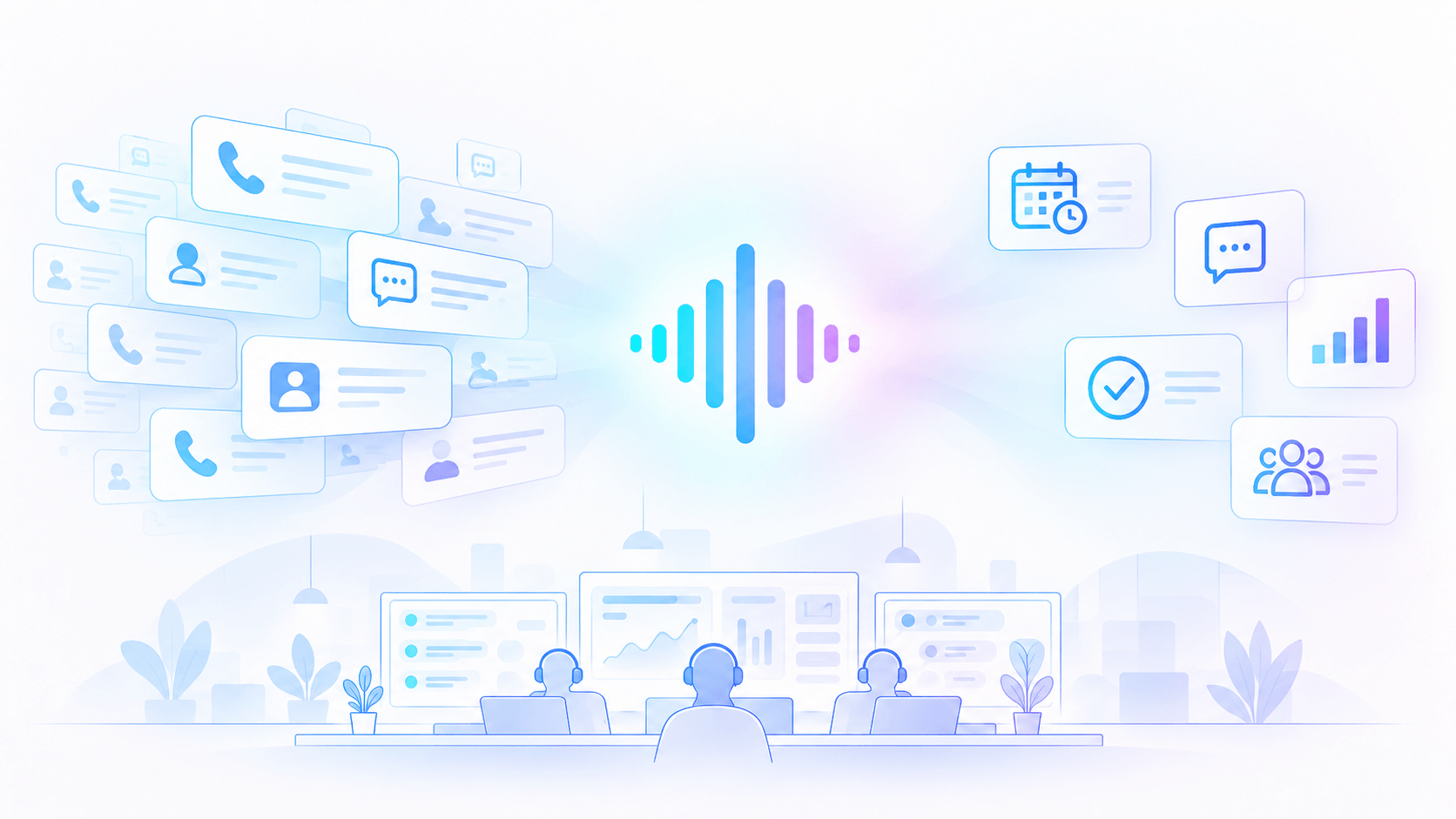


Support demand can rise faster than a team can hire and schedule people. AI voice agents for customer support solve this capacity problem by handling routine conversations in parallel while human agents focus on complex cases. The goal is not to replace the support team. It is to increase the calls an operation can manage without adding equivalent headcount.
This practical guide explains the model, why staffing struggles during spikes, how AI compares with IVR and human agents, what deployment changes, and how Indian businesses can evaluate fit.
It means increasing support capacity without adding one new human agent for every increase in call demand. AI voice agents can answer multiple suitable calls at the same time, follow defined workflows, retrieve available information, and complete routine actions.
Human agents stay available for cases that need judgment, negotiation, empathy, approvals, or exception handling. This creates a layered model: AI handles repetitive conversations first, while people handle the harder work.
Call deflection means resolving an eligible customer query through automation so it does not need to enter a human support queue.
That frees human capacity without forcing callers through unnecessary waiting.
A human agent normally handles one live voice conversation at a time. When demand rises suddenly, queues grow unless the business adds shifts, overtime, temporary staff, or permanent hires. That approach can be slow and difficult to scale for short demand spikes.
Common India-relevant triggers include:
These peaks may be temporary, but customers expect timely answers.
|
Capability |
AI voice agent |
Traditional IVR |
Human agent |
|
Understands natural speech |
Yes |
Limited |
Yes |
|
Resolves queries |
Routine workflows |
Menu-based |
Broad range |
|
Handles calls at the same time |
Many supported calls |
Many menu sessions |
One per agent |
|
Availability |
24/7 |
24/7 |
Shift-based |
|
Regional language support |
Configured languages |
Prompt-dependent |
Agent-dependent |
An AI voice agent vs IVR comparison matters because both automate calls, but they do not create the same customer experience or resolution path.
The difference is how each option receives intent, completes routine work, and decides when a person should take over.
Consider an Indian e-commerce customer checking a COD order delivery.
The support team stops spending as much time on predictable calls that follow repeatable workflows. Human agents remain responsible for complex requests, escalations, exceptions, and conversations where judgment matters.
The operational change is capacity allocation, not team replacement: automation handles suitable volume, while people handle the conversations that need people.
That gives agents more room to focus on difficult customer needs.
Good fit signs:
Not a good fit signs:
The best starting point is a narrow, repetitive process with a clear escalation path.
Audit call types: Review the reasons customers call and separate routine, repeatable requests from complex or sensitive cases.
The Valuez AI voice agent supports inbound and outbound calling with human handoff. Its AI Calling Agent can work 24/7 and supports 9+ languages, including Hindi, English, Marathi, Gujarati, Tamil, Telugu, Kannada, Sanskrit, and Ahirani.
Valuez AI can connect with CRMs and tools through Zoho CRM, WhatsApp, Zapier, webhooks, and REST API. Deployment can be cloud or on-premises, and average integration time is under 48 hours. It can route callers, book appointments live, and generate post-call summaries with outcome and next action.
AI can handle routine support calls in parallel while human agents manage complex cases and exceptions.
AI voice agents for customer support give operations teams a way to scale capacity when demand grows faster than hiring. They can manage suitable routine conversations in parallel, provide 24/7 customer support, and send harder cases to people with context instead of forcing every caller into the same queue.
The strongest use cases are repetitive, rules-based calls with clear data, actions, and escalation paths. Start with a narrow pilot, measure what is resolved and what still needs human help, then expand deliberately. If you are evaluating this model for your support operation, book a Valuez AI demo.
 1.png)
We're building something powerful for you. This feature will be available shortly.