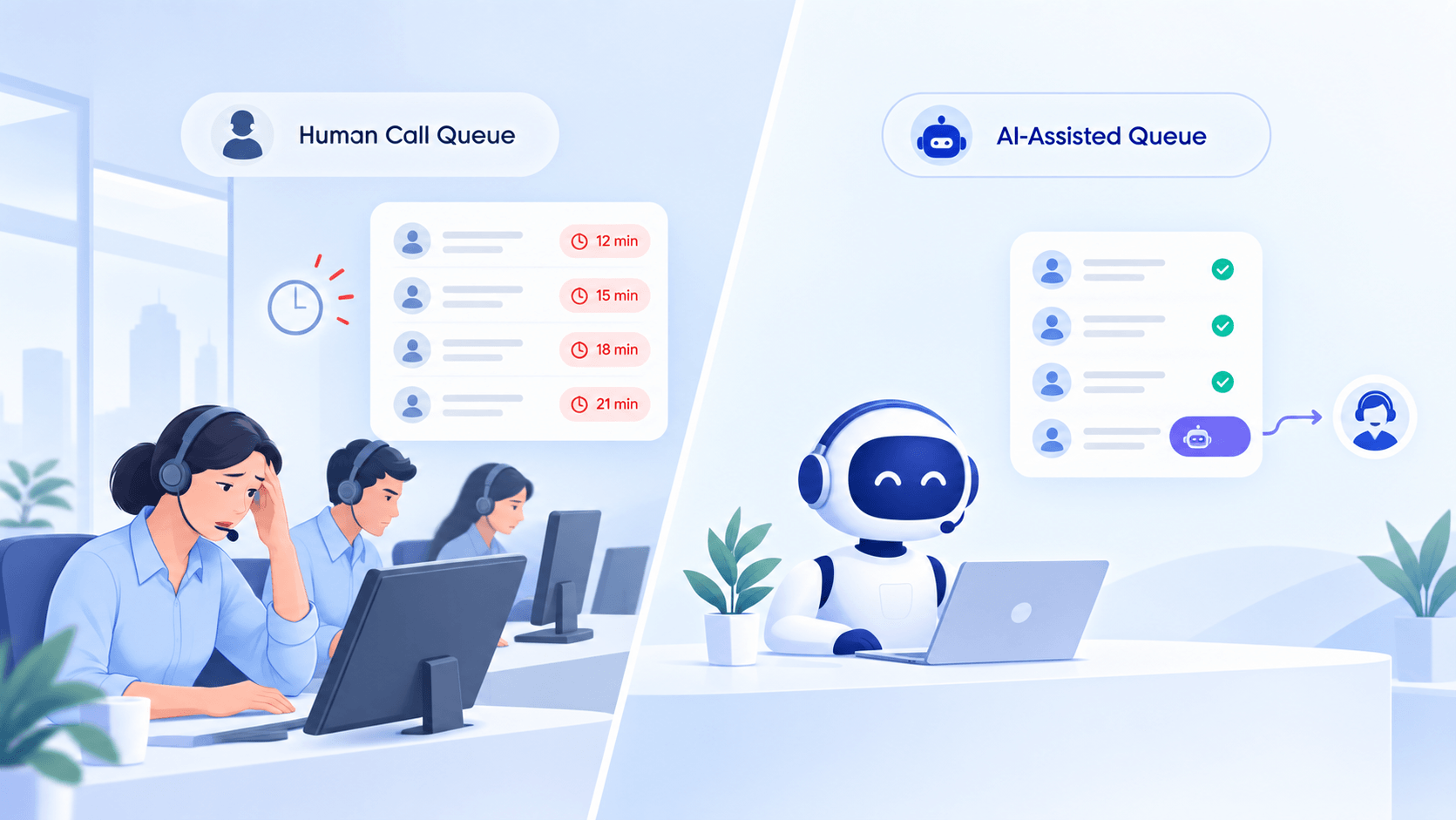


Customer support costs rise quickly when your team spends hours handling repetitive calls, overtime, training, and growing call volumes. Adding more agents may increase capacity, but it also increases the cost of handling routine work.
An AI Calling Agent can handle common calls such as order updates, appointment confirmations, and basic enquiries. It takes repetitive conversations off your team's workload, allowing human agents to focus on complex issues that need judgment and empathy.
An AI Calling Agent is software that can talk to customers over the phone using a natural voice. It listens to what the customer says, understands the request, and responds with the right information without needing a human agent on every call.
When connected to your CRM, helpdesk, or other business systems, an AI Calling Agent can check order status, confirm appointments, collect customer details, help with basic issues, and make follow-up calls.
It can handle both incoming and outgoing calls, even outside business hours. If a customer needs human help, the call can be transferred to an agent with the information already collected.
Support costs build up from several factors operating at once:
Individually manageable, together they explain why support budgets tend to grow every year even when the issues customers call about stay largely the same.
Much of support call volume is the same handful of questions repeated often order status, hours, pricing, return policy. An AI Calling Agent answers these directly from connected systems in real time, freeing agents to spend their day on calls that actually require judgment.
When call volume outpaces capacity, businesses typically hire more agents or accept longer wait times both add cost. An AI Calling Agent absorbs the high-volume, predictable workload, so the existing team can give complex cases more attention instead of being stretched thin.
Much of average handling time goes toward identity checks, lookups, and explaining standard policies rather than solving the issue itself. An AI Calling Agent collects this information upfront and pulls account details instantly, and hands over full context if a call needs a human agent.
Staffing a night or weekend desk is costly, and many businesses can't justify it for the after-hours volume they receive. An AI Calling Agent handles routine conversations around the clock without a separate night team, while complex issues are still queued for a human.
Promotions, launches, or unexpected disruptions can all cause sudden call spikes. Covering that with human agents usually means temporary hiring or overtime. Because an AI Calling Agent can manage many conversations at once, it absorbs much of the surge without expanding headcount right away.
Repeat calls happen when an issue wasn't fully resolved or logged correctly. An AI Calling Agent, integrated with business systems, gives the same consistent answer every time and logs details accurately, so fewer customers need to call back or get bounced between departments.
Onboarding a new agent takes time, and turnover means repeating that investment. An AI Calling Agent follows configured workflows consistently without retraining for every new hire updating a policy means updating it once centrally, not re-briefing a whole team.
A side-by-side view of how the two approaches typically compare:
|
Factor |
Traditional Support |
AI Calling Agent |
|
Availability |
Limited to shift hours |
Available 24/7 for routine queries |
|
Repetitive call handling |
Manual, repeated each time |
Automated and consistent |
|
Scaling during peak volume |
Requires hiring or overtime |
Absorbs surges without immediate hiring |
|
Response consistency |
Varies by agent and mood |
Consistent, system-based answers |
|
Human intervention |
Required for every call |
Reserved for complex or sensitive cases |
|
Training requirements |
Ongoing, repeated per new hire |
Configured once, updated centrally |
|
Cost structure |
Scales roughly with call volume |
Scales more efficiently with volume |
Answering hours, pricing, policy, or product questions a large share of daily call volume.
Giving real-time order, delivery, or service status by pulling data directly from connected systems.
Booking, confirming, or rescheduling appointments, and calling ahead to reduce no-shows.
Walking new customers through account setup consistently, regardless of call volume.
Guiding standard troubleshooting steps and logging complaints accurately before handing off if needed.
Placing post-service follow-ups and payment or renewal reminders without adding to an agent's workload.
The strongest business case tends to appear when a company is dealing with:
Customer support costs do not come only from the number of employees a business has. They also come from repetitive conversations, manual processes, long handling times, repeat calls, after-hours coverage, and sudden changes in call volume.
An AI Calling Agent can address these cost drivers by automating suitable customer conversations and creating an additional support layer around the human team.
The goal is not to remove human support. It is to make better use of it. When AI handles predictable and repetitive interactions, human agents can spend more time solving complex problems and supporting customers who need their expertise.
For businesses evaluating customer support automation, the opportunity is to start with the conversations that consume the most repetitive effort and measure the operational impact before expanding further.
 1.png)
We're building something powerful for you. This feature will be available shortly.