

Sales teams may have hundreds of leads to contact, but every call still takes time. Manual dialing, delayed responses, repetitive qualification and missed follow-ups can limit how many meaningful sales conversations a team actually handles.
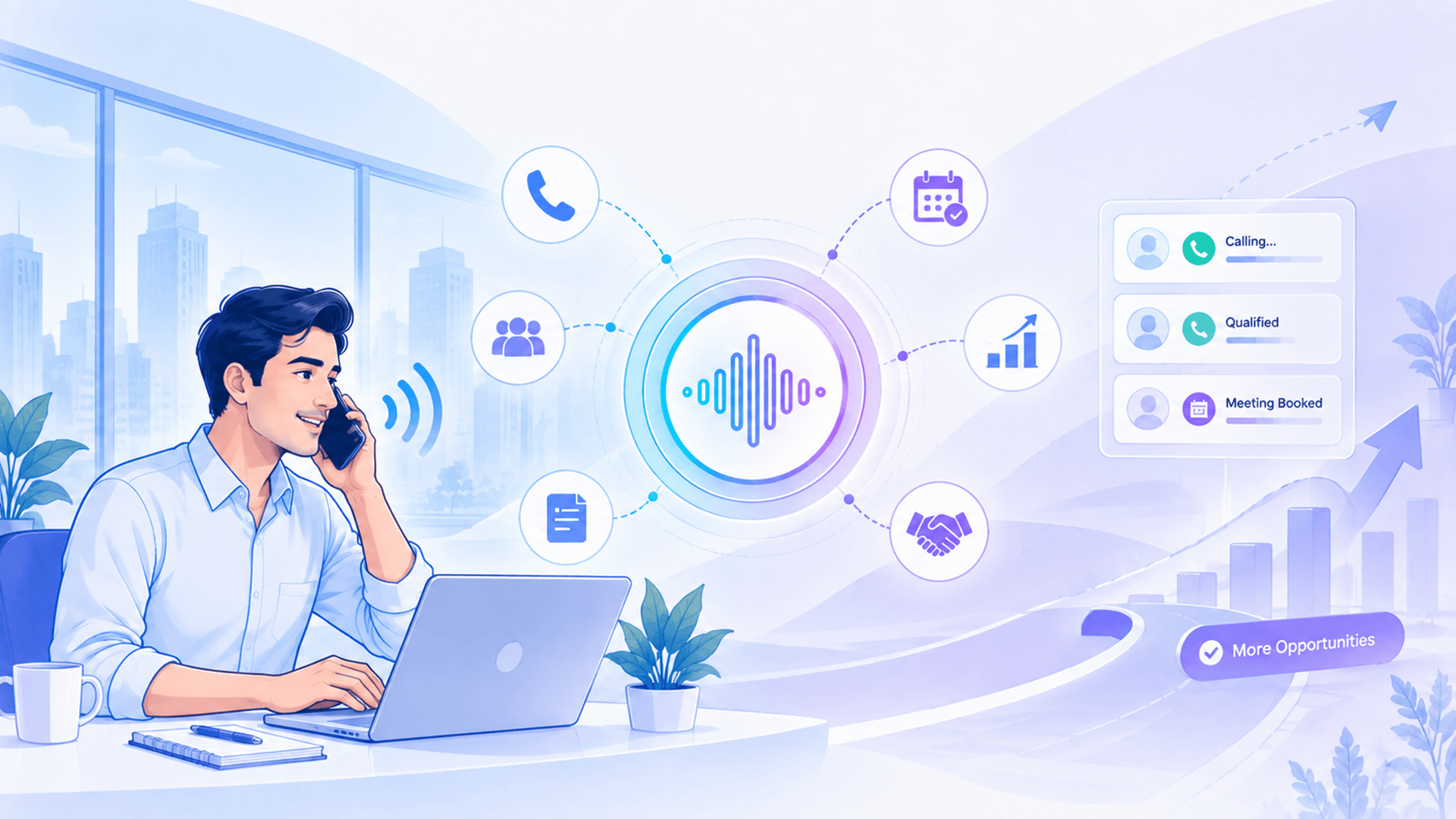
This is where AI Voice Agents are changing outbound sales. Instead of relying entirely on sales representatives to dial every lead, Voice AI can initiate conversations, understand responses, qualify prospects, schedule meetings and move interested leads to the right salesperson.
The result is not sales without people. It is a sales process where people spend more time on conversations that actually need them.
Outbound calling can create valuable sales conversations, but scaling it manually creates a capacity problem.
Sales representatives have to work through call lists, wait for prospects to answer, repeat qualification questions, update CRM records and remember when to follow up.
Meanwhile, opportunities can be lost because:
Adding more leads therefore does not automatically create more sales conversations. The team still needs enough capacity to contact, qualify and progress them.
AI Voice Agents for outbound sales address this capacity gap by automating the repetitive conversations around the sales process.
AI Voice Agents are conversational AI systems that can initiate phone calls, understand spoken responses and hold two-way conversations with prospects based on defined sales goals and business information.
Unlike traditional recorded robocalls that primarily deliver a predefined message, modern Voice AI listens to what the prospect says and determines how the conversation should continue.
An AI calling agent can ask qualification questions, respond to common queries, identify interest, schedule a meeting, record an outcome or transfer a promising conversation to a salesperson.
Speech recognition understands the prospect, conversational AI determines the response, voice technology speaks naturally, and integrations connect the conversation with systems such as CRM and scheduling platforms.
A typical AI outbound calling workflow can look like this:
Lead enters CRM or campaign
↓
AI Voice Agent initiates the call
↓
Prospect responds naturally
↓
AI identifies intent and context
↓
AI asks relevant qualification questions
↓
Common questions or objections are handled
↓
AI determines the appropriate next step
↓
Qualified lead is booked or transferred to sales
↓
Conversation outcome is recorded in the CRM
Instead of stopping at dialing automation, Voice AI for calls can automate parts of the conversation itself while keeping the next sales action connected to the wider workflow.
Traditional outbound sales requires a representative for almost every conversation, regardless of whether the prospect is interested, unavailable or ready to buy.
AI-powered calling changes where human sales capacity is used.
AI Voice Agents can manage high-volume initial outreach and repetitive qualification while following the same approved sales logic across conversations. They can also use available CRM or campaign context to make conversations more relevant.
When a prospect shows stronger buying intent, has complex requirements or wants to speak with someone, the conversation can move to a human salesperson.
The goal is simple: use automation for repeatable sales activity and people for conversations where human judgment can create greater value.
New enquiries can lose momentum while waiting in a sales queue. AI Voice Agents can trigger outbound contact based on defined workflows, reducing dependence on a representative becoming available first.
Not every dial results in a meaningful sales conversation. Automating appropriate initial outreach lets representatives spend more of their available time speaking with prospects who need human attention.
Different representatives may ask different questions or record information differently. AI can follow structured qualification logic based on the company's defined criteria and capture answers consistently.
Interested prospects do not always make decisions after one conversation. AI-powered follow-up workflows can help ensure scheduled outreach happens instead of relying entirely on manual reminders.
A fixed sales team has limited calling hours. Voice AI can provide additional calling capacity for appropriate campaigns without requiring every conversation to start with a representative.
Early qualification can identify whether a prospect has genuine interest, meets defined criteria or needs further nurturing before consuming a salesperson's time.
The value of Voice AI for sales becomes clearer when it is connected across the sales journey rather than treated simply as an automated dialer.
Voice AI can support:
Lead response → Initial conversation → Qualification → Follow-up → Appointment booking → Human handoff
For example, a prospect submits an enquiry. The AI calls, understands what the prospect needs and asks relevant qualification questions. If the prospect is interested, it can help schedule a meeting or route the conversation to sales.
If the prospect needs more time, the outcome can instead trigger an appropriate follow-up.
This creates a division of work where AI manages repetitive, scalable conversations while sales representatives concentrate on discovery, relationships, negotiation and closing.
A new enquiry can trigger an outbound call based on business-defined rules. The AI can identify the reason for the enquiry, collect initial requirements and determine the next action.
Business value: Faster movement from enquiry to conversation.
AI Voice Agents can ask consistent questions about requirements, interest, timeline, location, budget or other qualification criteria relevant to the business.
Business value: Salespeople receive better context before engaging with a prospect.
Where permitted and appropriately targeted, AI calling agents can support outbound campaigns by starting conversations and identifying prospects interested in continuing.
Business value: More available calling capacity without requiring sales representatives to handle every initial interaction.
When a prospect expresses interest, Voice AI can connect with scheduling workflows to move the conversation toward a demo, consultation or sales appointment.
Business value: Fewer steps between prospect interest and the next sales conversation.
AI can support defined follow-up workflows after an enquiry, previous conversation, demo or proposal and capture the prospect's current status
Business value: More consistent follow-up across the pipeline.
Older leads often remain untouched because sales teams prioritize new opportunities. AI Voice Agents can reconnect with appropriate previous prospects and identify whether interest has changed.
Business value: Existing lead databases can become another source of potential sales conversations.
AI Voice Agents and sales representatives are strongest when they handle different parts of the process.
|
AI Voice Agents |
Human Sales Teams |
|
Initial outreach |
Complex discovery |
|
Repetitive qualification |
Consultative selling |
|
Routine follow-ups |
Relationship building |
|
Common questions |
Complex objections |
|
Appointment scheduling |
Negotiations |
|
Lead routing |
High-value opportunities |
|
High-volume calling |
Closing |
AI increases sales capacity; humans provide judgment, relationships and closing expertise.
The objective is not to remove people from sales. It is to prevent valuable human sales time from being consumed by tasks that can be handled consistently through automation.
The real value of AI outbound calling should be evaluated through business outcomes rather than the number of calls the technology can make.
Automated workflows can reduce the time between a qualifying trigger and the first appropriate outreach.
Additional calling capacity can help teams work through larger eligible lead volumes.
Structured questions and captured context can help representatives understand a prospect before taking over.
Defined calling workflows help keep opportunities moving without depending entirely on manual reminders.
Representatives can spend less time on repetitive calling and more time on qualified conversations.
Businesses can increase appropriate outreach capacity during campaigns or periods of higher lead volume without scaling manual calling at the same rate.
A strong outbound Voice AI solution needs more than a realistic voice.
Businesses should evaluate:
The right system should fit into the existing sales process rather than creating another disconnected calling tool.
Outbound AI calling must be designed around applicable regulations, consent requirements and customer expectations.
Requirements vary by country, region and type of call. Still, businesses may need to consider appropriate consent, caller identification, AI or automated-call disclosure, permitted calling times, do-not-call requirements, opt-out handling, recording rules and data privacy.
Compliance should therefore be part of the workflow from the beginning, not something added after a campaign launches.
Businesses should obtain appropriate legal guidance for the jurisdictions and use cases in which they operate.
 1.png)
We're building something powerful for you. This feature will be available shortly.