

Businesses in 2026 need faster and smarter customer communication. Traditional IVR systems helped companies automate calls for years, but customers now expect natural conversations instead of long “Press 1” menus. This shift is driving enterprises toward AI Voice Agent technology powered by Conversational AI.
An AI Voice Agent can understand customer intent, respond in real time, and handle conversations more naturally using speech-to-text and text-to-speech technology.
Unlike Traditional IVR systems, AI voice agents can answer questions, book appointments, qualify leads, and provide 24/7 support without frustrating call flows.
As customer expectations continue to grow, enterprises are replacing Traditional IVR systems with Conversational AI solutions that improve customer experience, reduce waiting time, and increase operational efficiency.
In this blog, we will compare AI Voice Agent vs Traditional IVR systems and explain why AI-powered voice automation is becoming the preferred choice for businesses in 2026.
An AI Voice Agent uses conversational AI to understand speech, answer questions, and automate customer conversations naturally across calls, support, and sales processes.
It helps businesses provide faster responses, reduce manual workload, and deliver human-like customer interactions with real-time speech-to-text and text-to-speech technology.
Traditional IVR Systems are automated phone systems that guide callers through pre-recorded menus using keypad inputs or fixed voice commands for customer support and call routing.
Traditional IVR Systems follow rule-based workflows and cannot understand natural conversations, often creating longer wait times and frustrating customer experiences for businesses and callers.
AI Voice Agent and Traditional IVR Systems both automate customer calls, but they deliver completely different customer experiences. Modern businesses now prefer Conversational AI for faster, smarter, and more natural communication.
AI Voice Agent and Traditional IVR System technologies both automate customer calls, but they work very differently. AI-powered conversations deliver faster, smarter, and more human-like experiences compared to menu-driven IVR systems.
|
Feature |
AI Voice Agent |
Traditional IVR System |
|
Communication Style |
Understands natural conversations |
Uses fixed menus and keypad inputs |
|
Customer Experience |
Human-like and interactive |
Robotic and repetitive |
|
Intent Understanding |
Detects customer intent using AI |
Follows predefined commands only |
|
Response Speed |
Provides real-time intelligent responses |
Slower due to menu navigation |
|
Availability |
24/7 automated support |
Limited by programmed workflows |
|
Personalization |
Delivers contextual responses |
Offers generic responses |
|
Multilingual Support |
Supports multiple languages naturally |
Limited language flexibility |
|
Scalability |
Easily handles high call volumes |
Requires manual system expansion |
|
Learning Capability |
Improves through AI learning |
Cannot learn from conversations |
|
Integration |
Connects with CRM and business tools |
Limited integrations |
|
Lead Qualification |
Automatically qualifies leads |
Mostly transfers calls manually |
|
Maintenance |
Easier AI-based updates |
Complex manual updates |
AI Voice Agent technology enables real-time human-like communication, while Traditional IVR System interactions depend on robotic menu selections and scripted responses.
AI Voice Agents reduce customer frustration by providing faster, smoother, and more personalized support compared to traditional IVR workflows.
AI Voice Agents understand customer intent and context instead of relying only on predefined commands and button-based navigation systems.
Businesses can automate support, lead qualification, bookings, and customer interactions more efficiently using AI-powered voice automation solutions.
AI Voice Agents learn from conversations and improve performance over time, unlike Traditional IVR Systems that require constant manual updates.
Modern enterprises prefer AI Voice Agents because they improve efficiency, scalability, customer satisfaction, and overall communication performance in 2026.
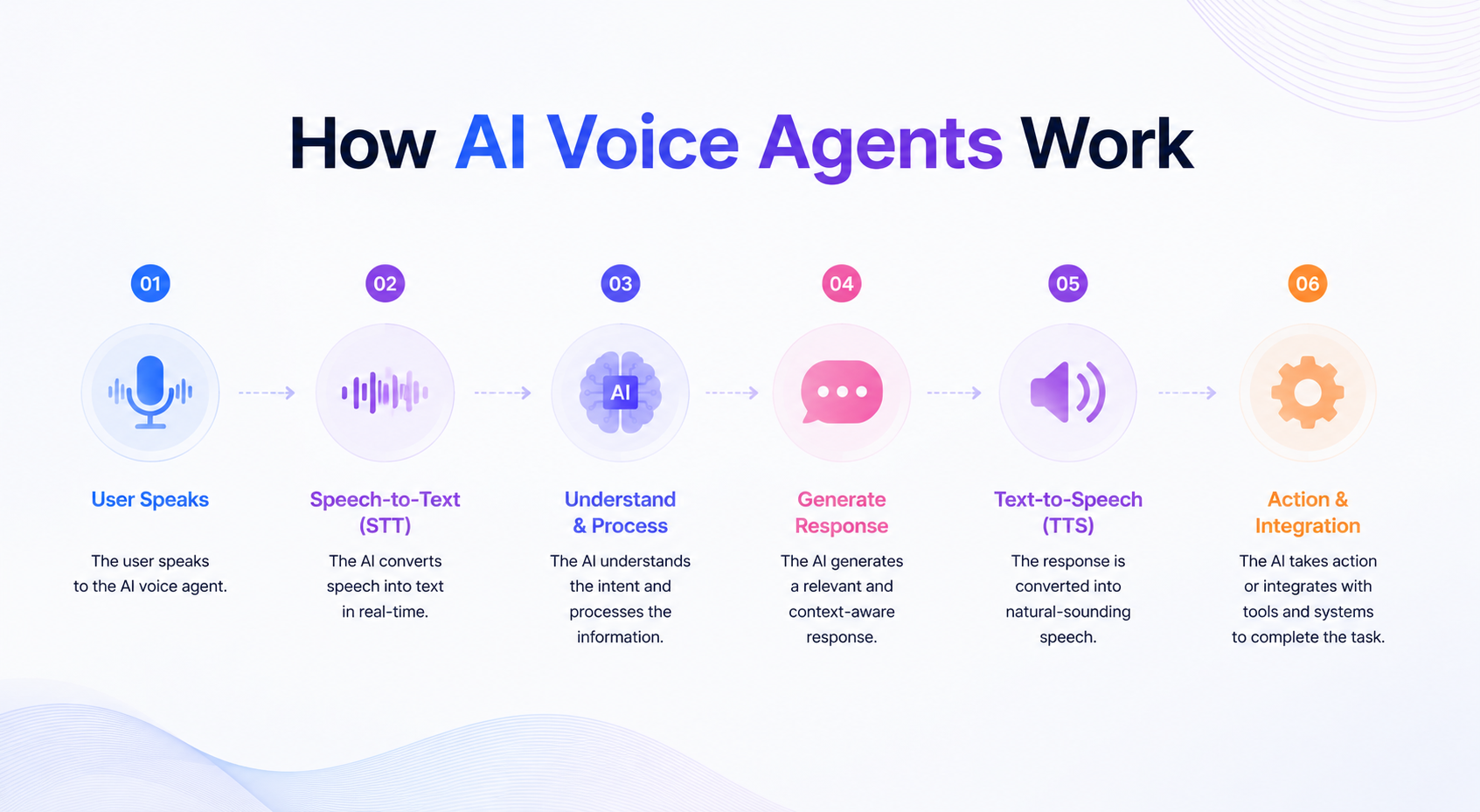
AI Voice Agents work by listening to spoken input, converting it into text, understanding user intent through AI models, generating intelligent responses, and converting them back into natural speech while integrating with external tools and workflows in real time.
Modern businesses are replacing fixed phone menus with Conversational AI solutions that deliver faster, smarter, and more human-like customer interactions across support, sales, appointment booking, and enterprise communication channels.
Conversational AI enables businesses to automate voice conversations using natural language understanding, speech recognition, and intelligent real-time responses.
Rule-Based IVR Systems depend on pre-defined call flows and keypad inputs, limiting flexibility and customer experience during interactions.
Businesses are moving toward Conversational AI because customers now expect faster, smarter, and more natural interactions instead of complex menu-based calling systems and long waiting times during support conversations.
In 2026, enterprises need faster, smarter, and more personalized customer communication. An AI Voice Agent helps businesses automate conversations while improving customer experience, operational efficiency, and response accuracy.
Traditional IVR Systems helped businesses automate calls, but customer expectations have changed significantly in 2026. Enterprises now need faster, smarter, and more natural communication experiences across support, sales, and customer engagement.
An AI Voice Agent provides real-time conversations, understands customer intent, and improves operational efficiency with intelligent automation. It reduces waiting time, increases productivity, and delivers better customer experiences compared to menu-driven IVR systems.
Businesses adopting Conversational AI gain a competitive advantage through scalable, 24/7 voice automation. As enterprise communication continues evolving, AI Voice Agents are becoming the smarter and future-ready alternative to Traditional IVR Systems.
 1.png)
We're building something powerful for you. This feature will be available shortly.

