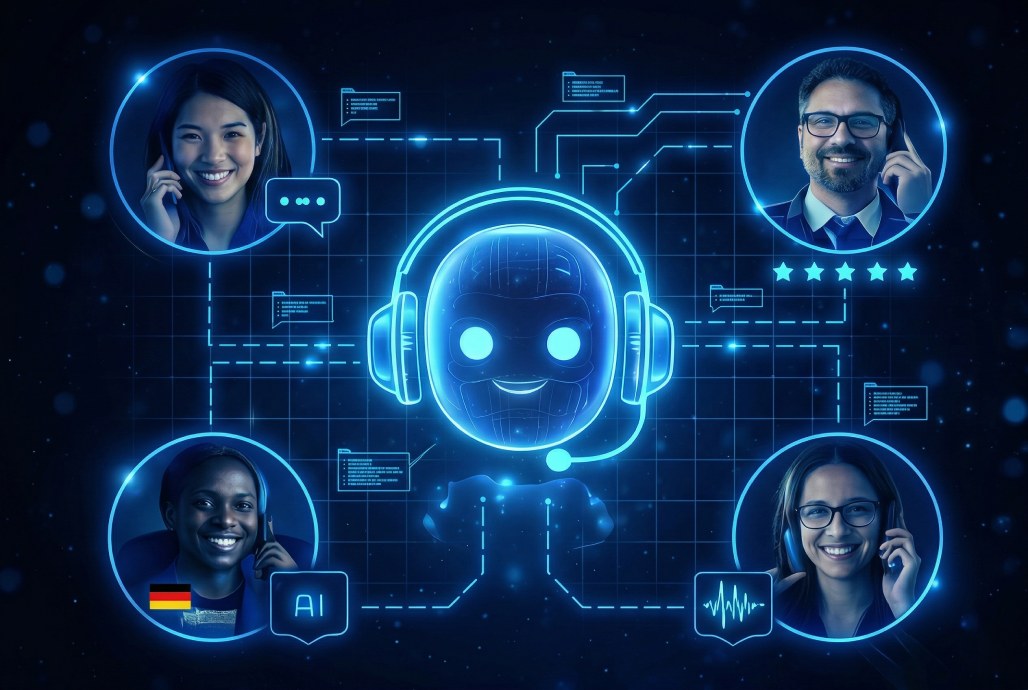


Enterprises now need to automate large volumes of customer interactions across calls, support, and operations while reducing wait times and operational costs. A Voice AI Platform enables this by allowing systems to understand, process, and respond to human speech in real time, creating faster and more efficient communication at scale.
Unlike traditional systems, a Voice AI Platform combines technologies like speech recognition, natural language processing, and voice synthesis to deliver human-like conversations. It helps businesses handle thousands of interactions simultaneously, improve response quality, and turn voice into a core interface for modern enterprise workflows.
Voice AI is technology that enables machines to understand, process, and respond to human speech in real time. It combines speech recognition, natural language processing, and voice synthesis to create natural conversations. Voice AI helps businesses automate calls, support queries, and interactions while delivering fast, human-like responses at scale across channels.
Enterprises need Voice AI to handle growing customer interactions efficiently while reducing costs, delays, and dependency on large support teams.
Voice AI platforms rely on multiple advanced technologies working together to understand speech, process intent, and deliver accurate, human-like responses.
Converts spoken language into text, enabling systems to accurately capture user intent from voice inputs across different accents and environments.
Transforms text responses into natural, human-like voice output, making interactions more engaging and conversational.
Interprets context, intent, and meaning from text, allowing Voice AI to understand complex queries and respond appropriately.
LLMs power advanced conversational abilities by generating relevant, context-aware responses. They enable Voice AI to handle complex queries, maintain conversation flow, and continuously improve interactions at scale.
Voice AI works by converting speech into data, understanding intent, and responding with natural, human-like voice interactions in real time.
This end-to-end process allows Voice AI to deliver fast, scalable, and human-like conversations across enterprise use cases.
A Voice AI platform includes advanced capabilities that help enterprises automate conversations, improve efficiency, and deliver human-like interactions at scale across customer support, sales, and operations environments.
Voice AI platforms help enterprises automate communication, improve efficiency, and deliver fast, scalable, and intelligent voice interactions across business operations.
Voice AI enables enterprises to handle large volumes of support calls without human dependency. It delivers instant responses, resolves common queries, and reduces wait times.
Voice AI helps capture, qualify, and engage leads through real-time conversations. It ensures no opportunity is missed while improving conversion rates.
Enterprises use Voice AI to manage bookings, confirmations, and reminders without manual effort. This improves operational efficiency and reduces missed appointments.
Voice AI supports internal workflows by assisting employees with tasks and information through voice commands.
Voice AI allows enterprises to communicate with global audiences in multiple languages and accents.
Voice AI captures valuable conversation data to improve business decisions and performance.
Enterprises adopting Voice AI platforms can transform how they handle customer interactions, internal processes, and data-driven decisions. By combining speech recognition, natural language processing, and voice synthesis, these platforms deliver fast, human-like conversations at scale, improving efficiency and reducing operational costs.
From automating support and sales calls to enabling multilingual engagement and real-time analytics, Voice AI empowers enterprises to scale operations, enhance customer experiences, and make informed decisions. Implementing a Voice AI platform ensures businesses stay competitive, responsive, and future-ready in an increasingly digital and voice-driven world.
 1.png)
We're building something powerful for you. This feature will be available shortly.